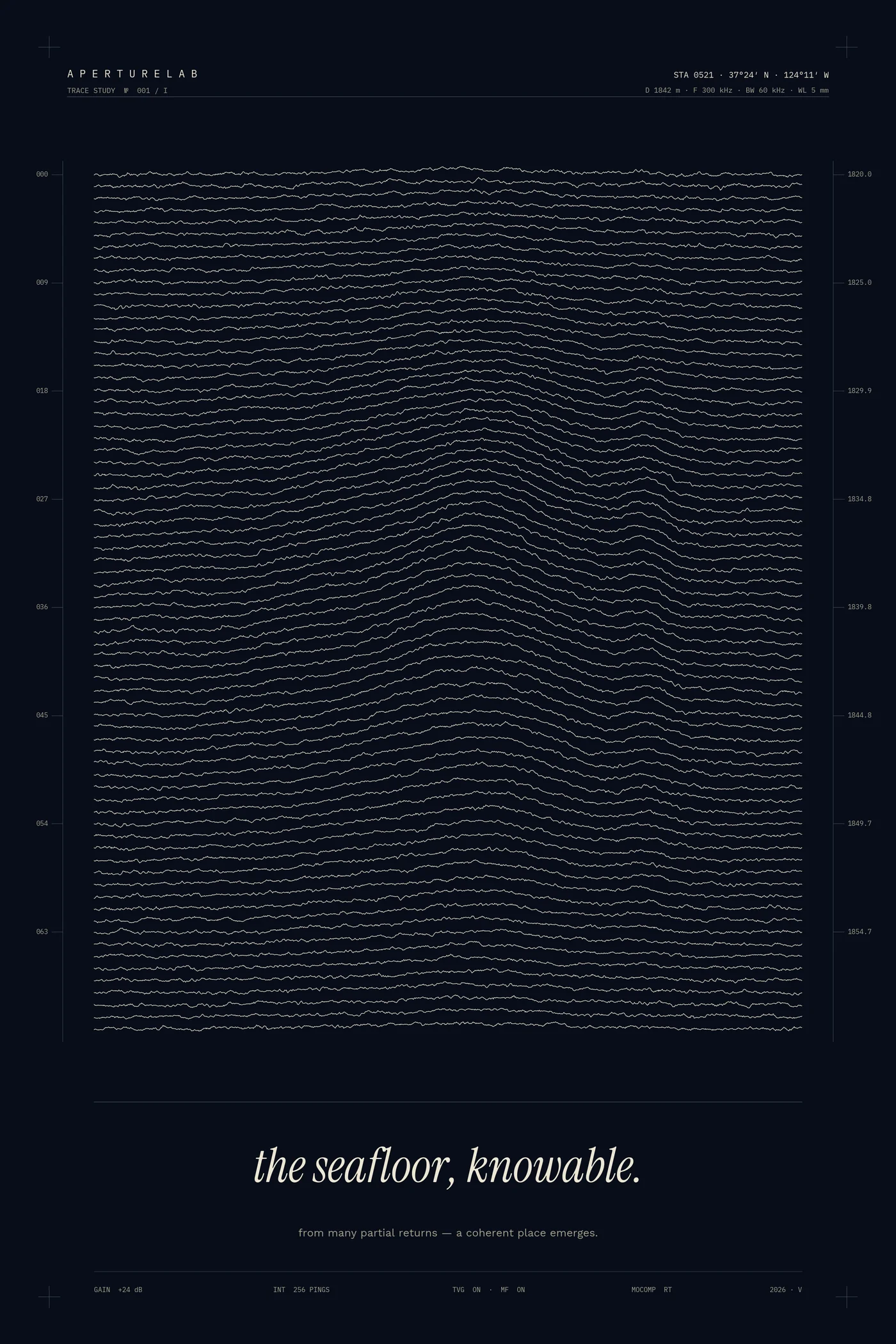
The research record behind ApertureLab comprises 29 peer-reviewed publications across 14 years. It covers the complete chain, from acoustic wave scattering through image formation to the models that read the resulting imagery. ApertureLab is the current state of that line of work.
The three papers below underlie ApertureLab's physics engine and beamformer: GPU-accelerated time-domain back-projection (TDBP), interpolation kernels for sub-wavelength micronavigation, and a validated simulation of sub-bottom acoustics.
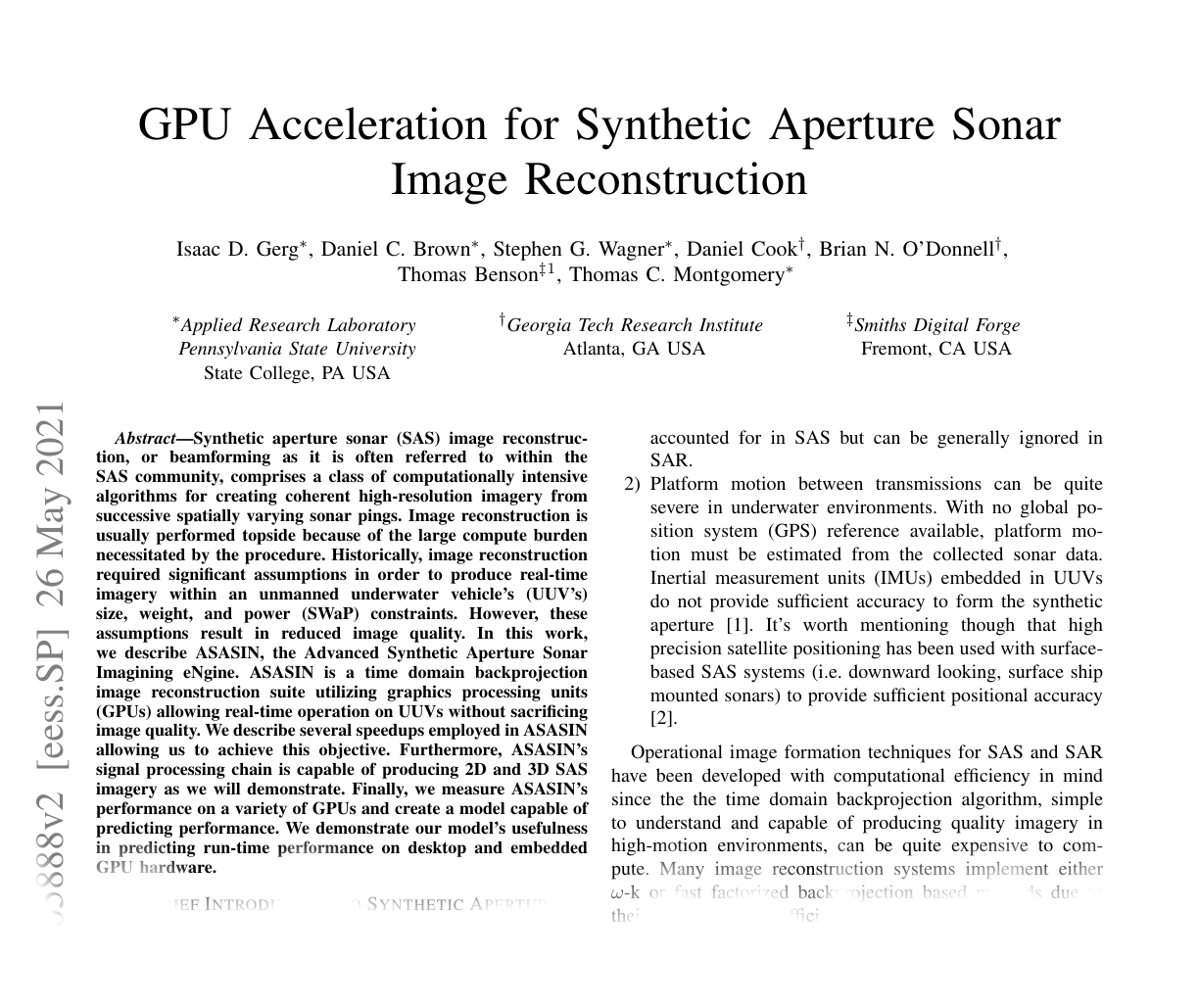
GPU Acceleration for Synthetic Aperture Sonar Image Reconstruction
The paper describes a GPU-accelerated TDBP image reconstruction suite for real-time SAS imaging on unmanned underwater vehicles.
Read paper →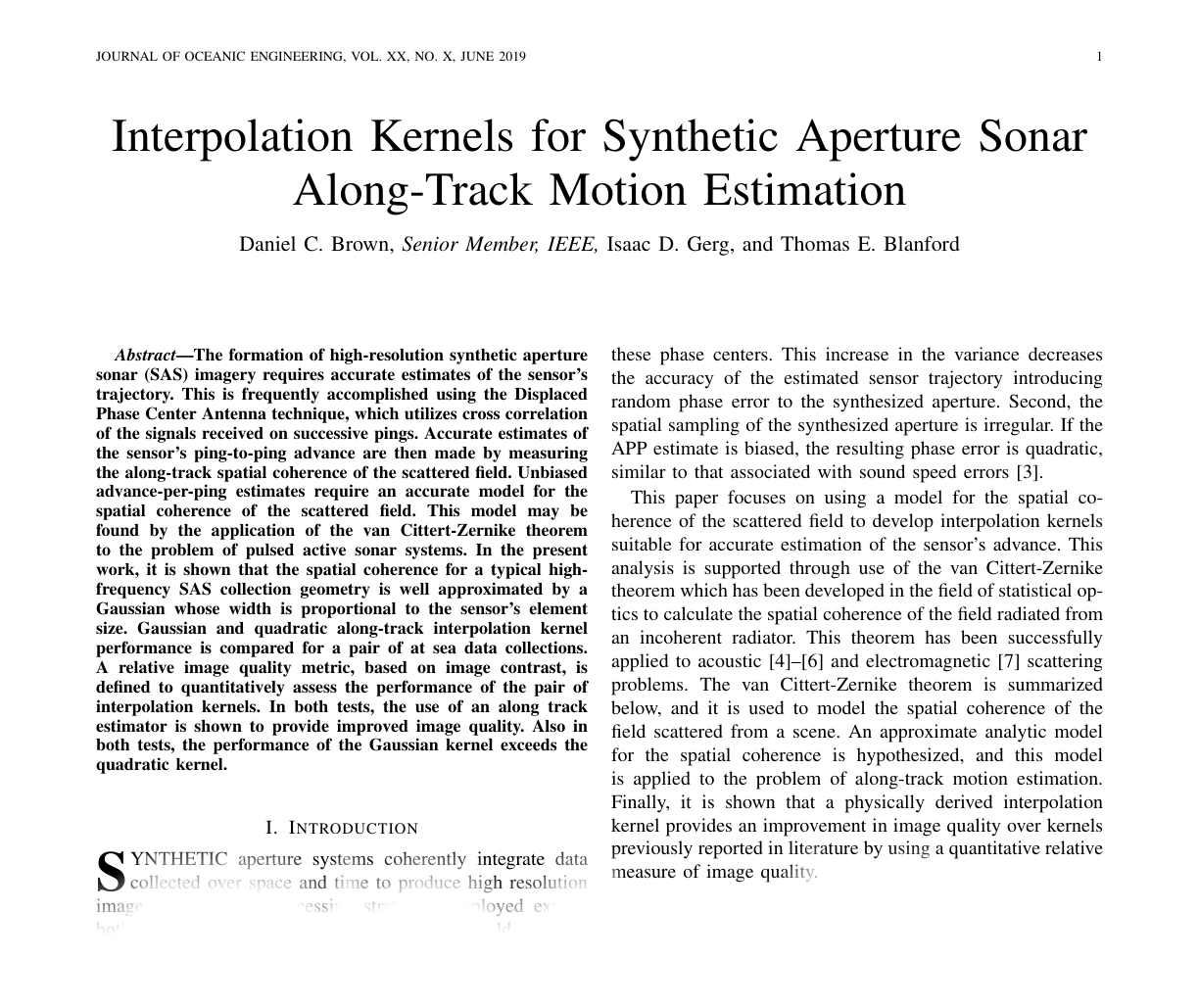
Interpolation Kernels for Synthetic Aperture Sonar Along-Track Motion Estimation
The interpolation kernels designed here for sub-wavelength along-track displacement estimation underlie ApertureLab's micronavigation pipeline.
Read paper →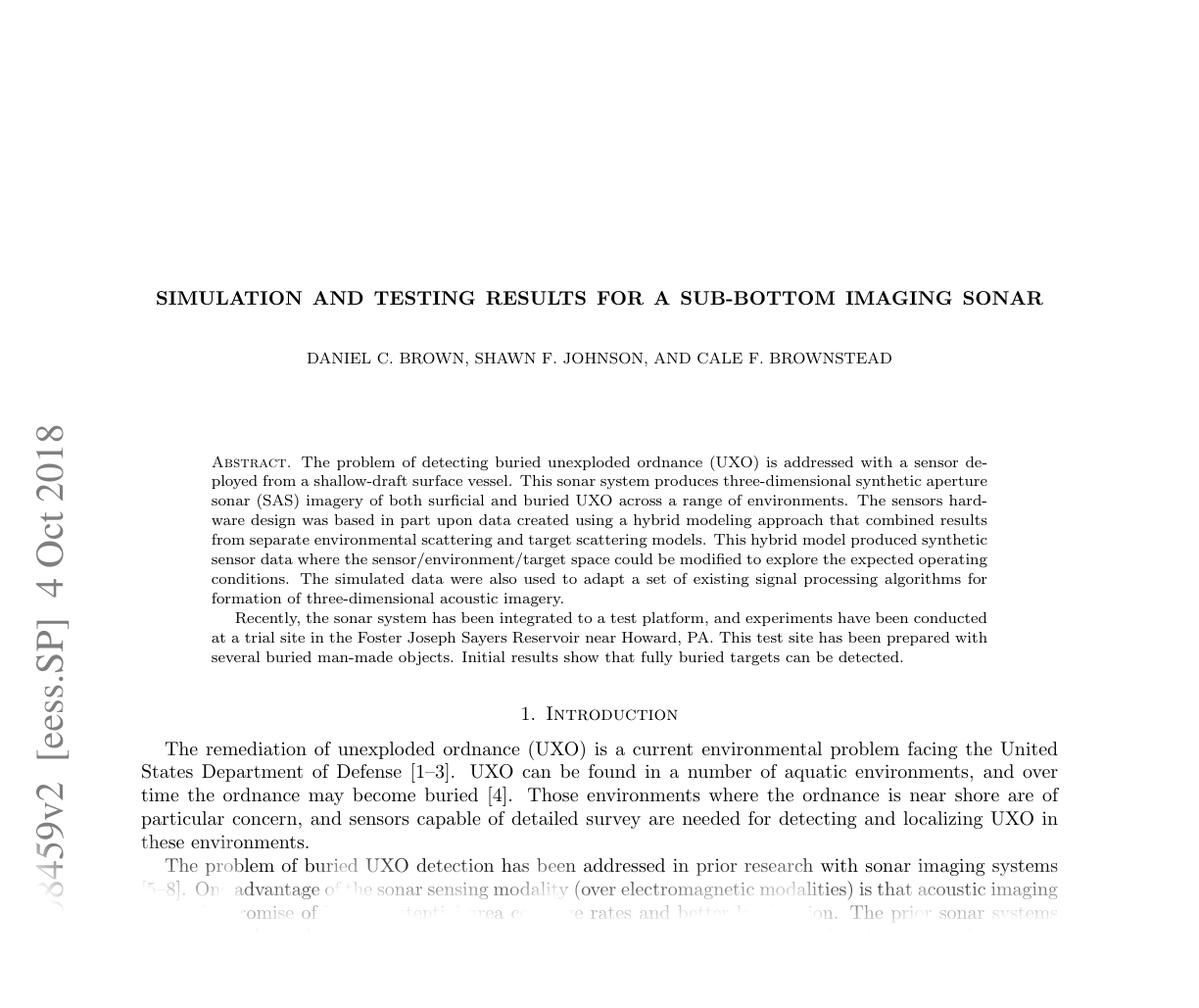
Simulation and Testing Results for a Sub-Bottom Imaging Sonar
The paper validates a simulation of sub-bottom acoustic scattering; the same physics model underlies ApertureLab's seafloor rendering.
Read paper →The three papers below trace the use of synthetic data in SAS machine learning. They run from synthesizing scarce training data with a physics-coupled GAN, to few-shot classifiers trained with synthetic augmentation, to zero-shot vision-language models (VLMs) that classify sonar imagery from a text prompt alone.
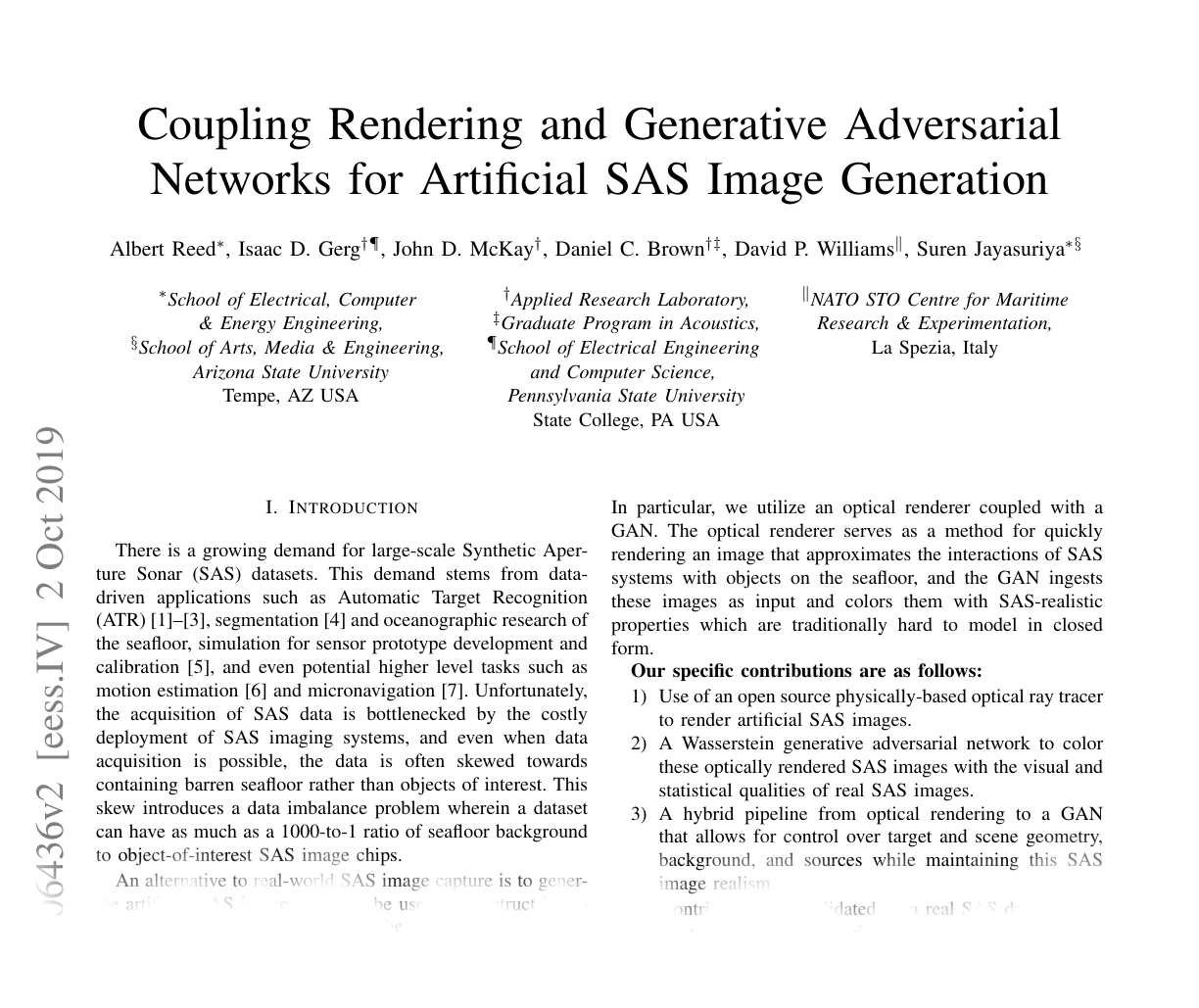
Coupling Rendering and Generative Adversarial Networks for Artificial SAS Image Generation
A physics renderer coupled with a GAN produces realistic SAS target imagery when labeled field data is too scarce to train from alone.
Read paper →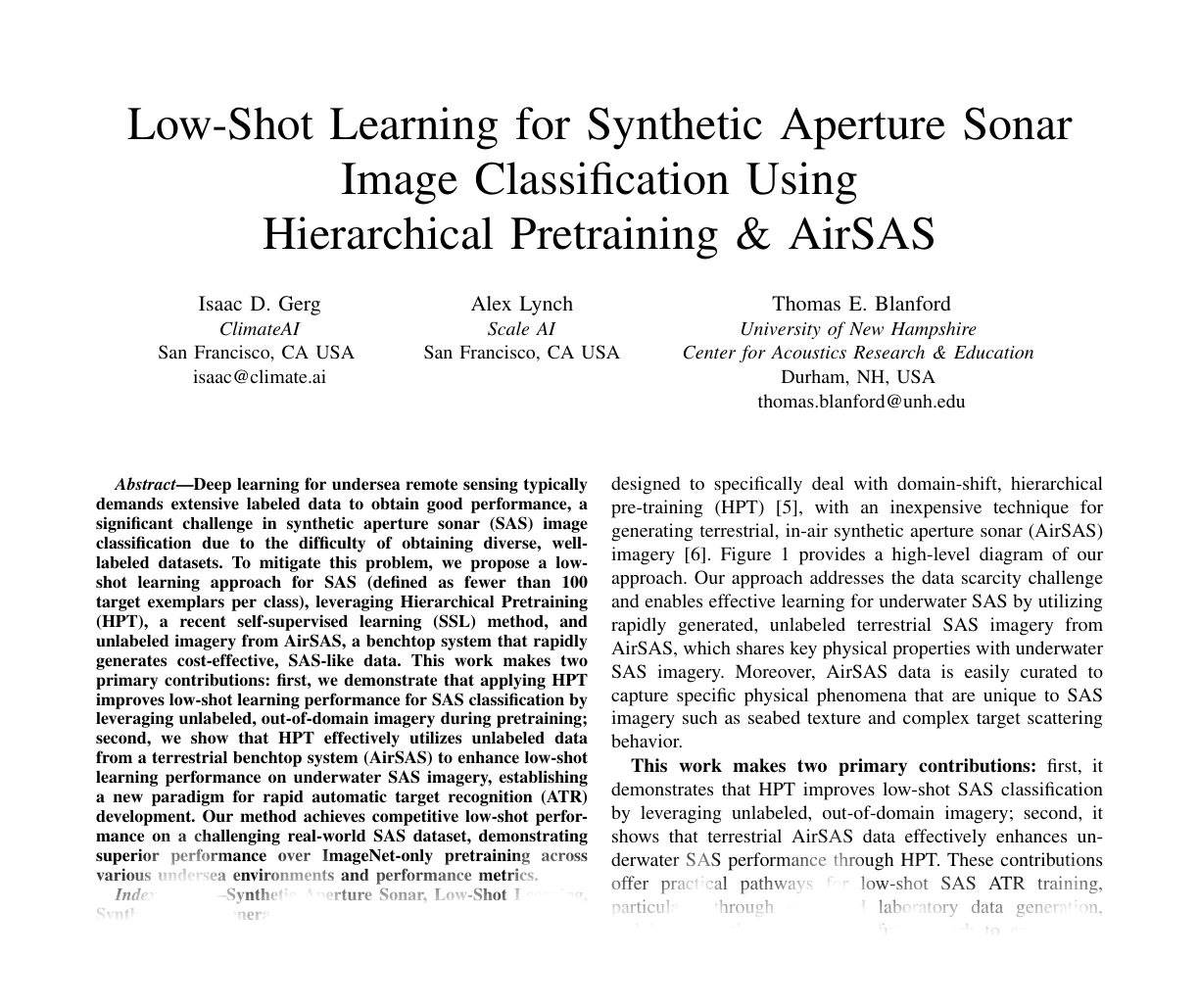
Low-Shot Learning for Synthetic Aperture Sonar Image Classification Using Hierarchical Pretraining & AirSAS
Hierarchical pretraining on AirSAS synthetic data reduces labeled-data requirements to a handful of real examples per class.
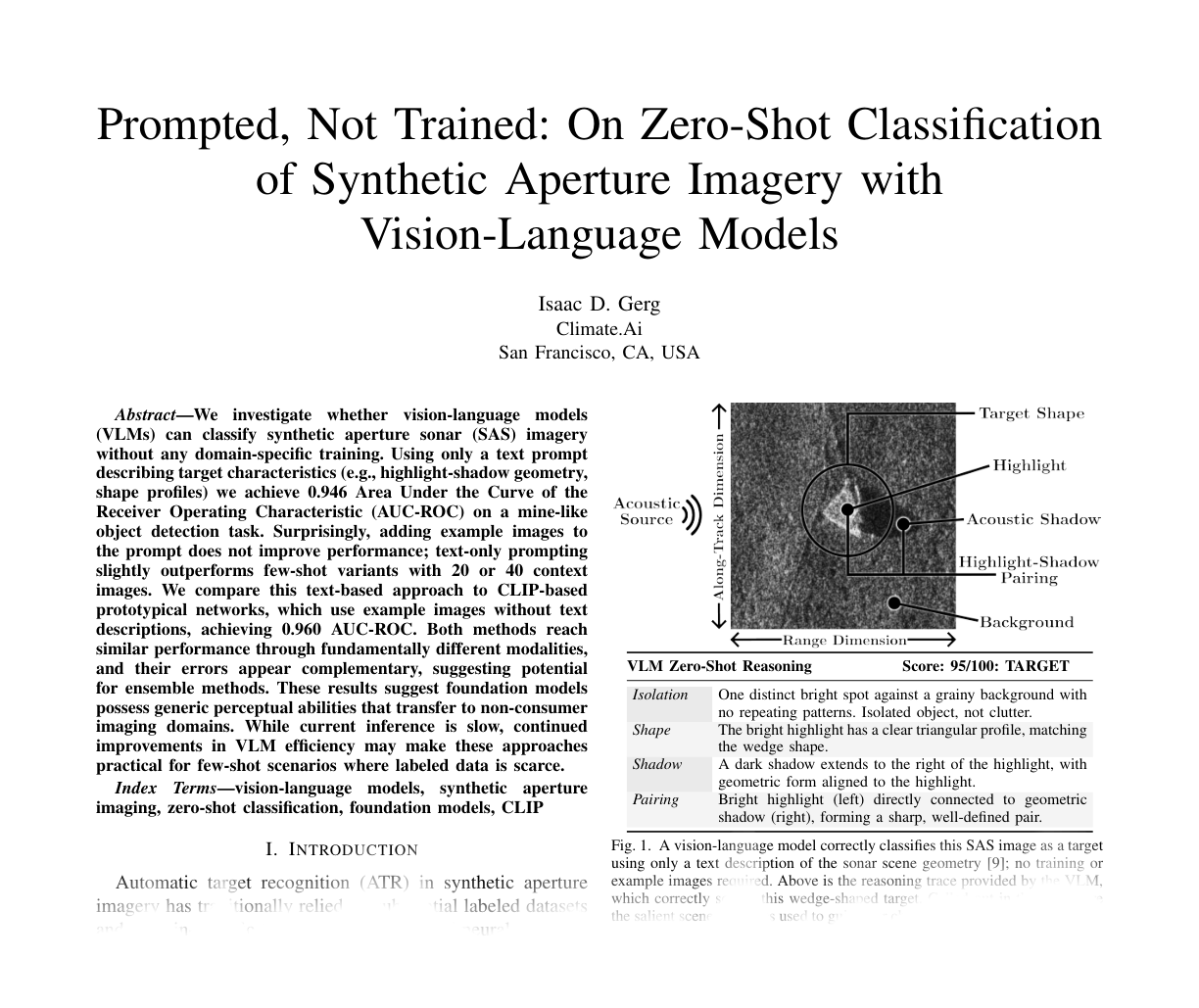
Prompted, Not Trained: On Zero-Shot Classification of Synthetic Aperture Imagery with Vision-Language Models
VLMs classify SAS targets at 0.946 AUC using only text prompts that describe highlight-shadow geometry, with no domain-specific training.
To appear.The cards above are a selection from 29 publications across 14 years. The complete record spans physics-based simulation and synthetic data, micronavigation, GPU image formation, learned autofocus, compression, perceptual image quality, and the models that read the imagery. The diagram below places each paper on the stage of the processing chain it advances.
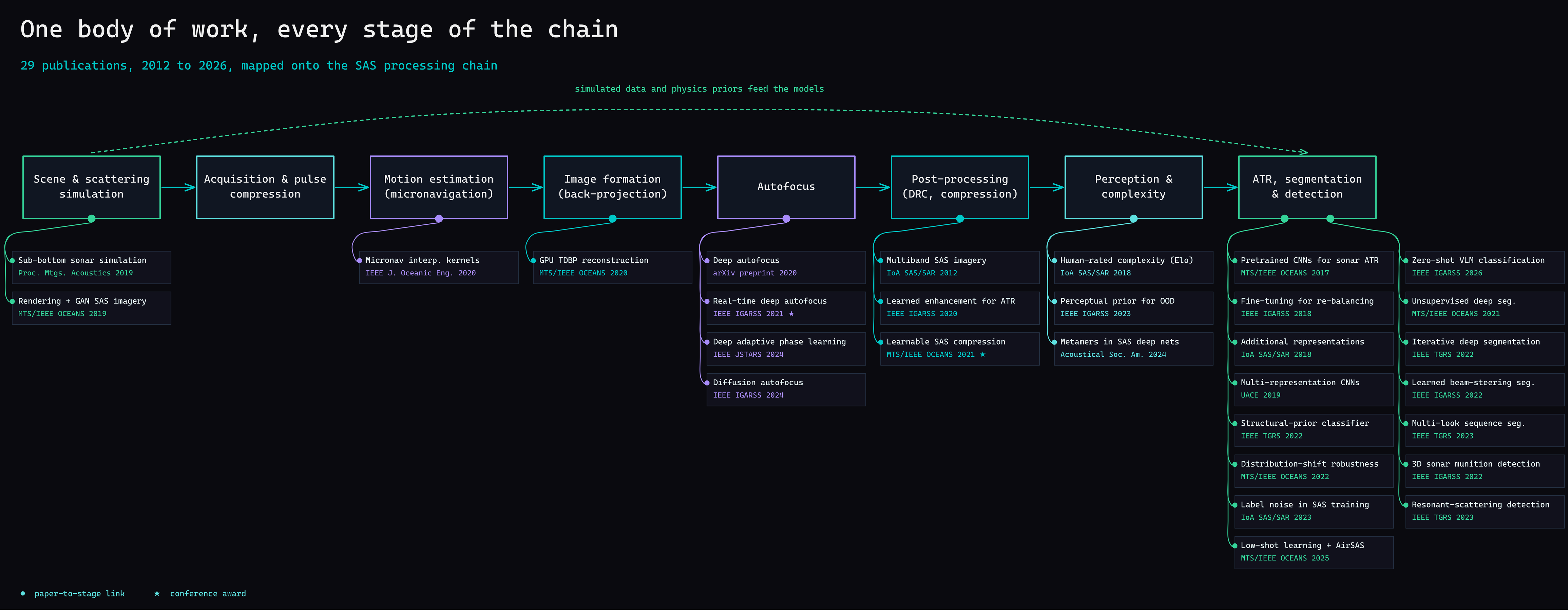
29 publications, 2012 to 2026, mapped onto the SAS processing chain; each line ties a paper to the stage it advances.