DRAFT · this page is currently under construction.

Kirchhoff facets and point scatterers

ApertureLab simulates an object on the seabed either as point scatterers drawn over its surface or as Kirchhoff facets, each mesh triangle scattering by the closed-form Kirchhoff integral of Abawi (2016). On one simulated scene the faceted objects image mostly as outlines and glints, and the brightest pixel in the image rises by 14.2 dB.

Comparison

One scene with two object models

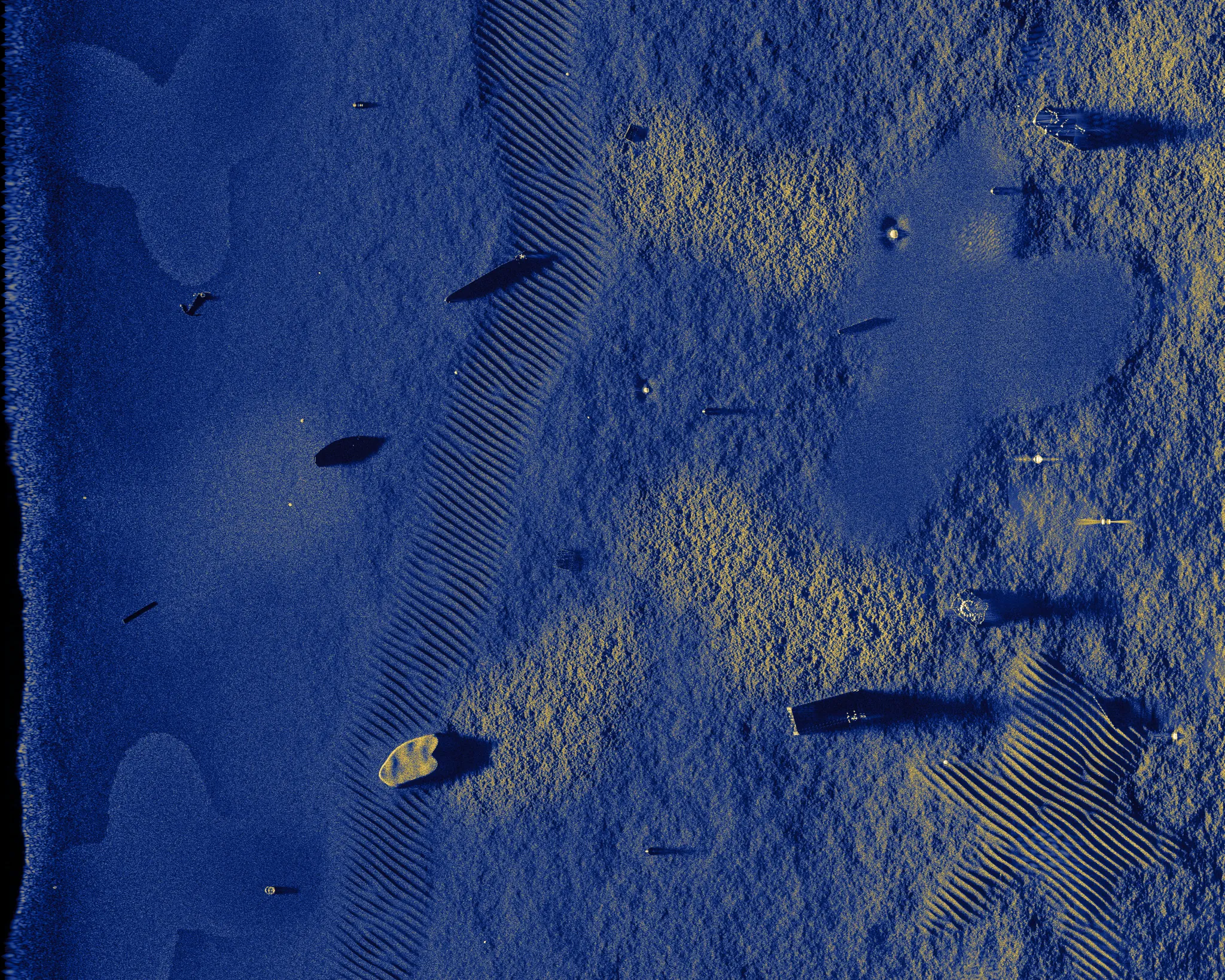
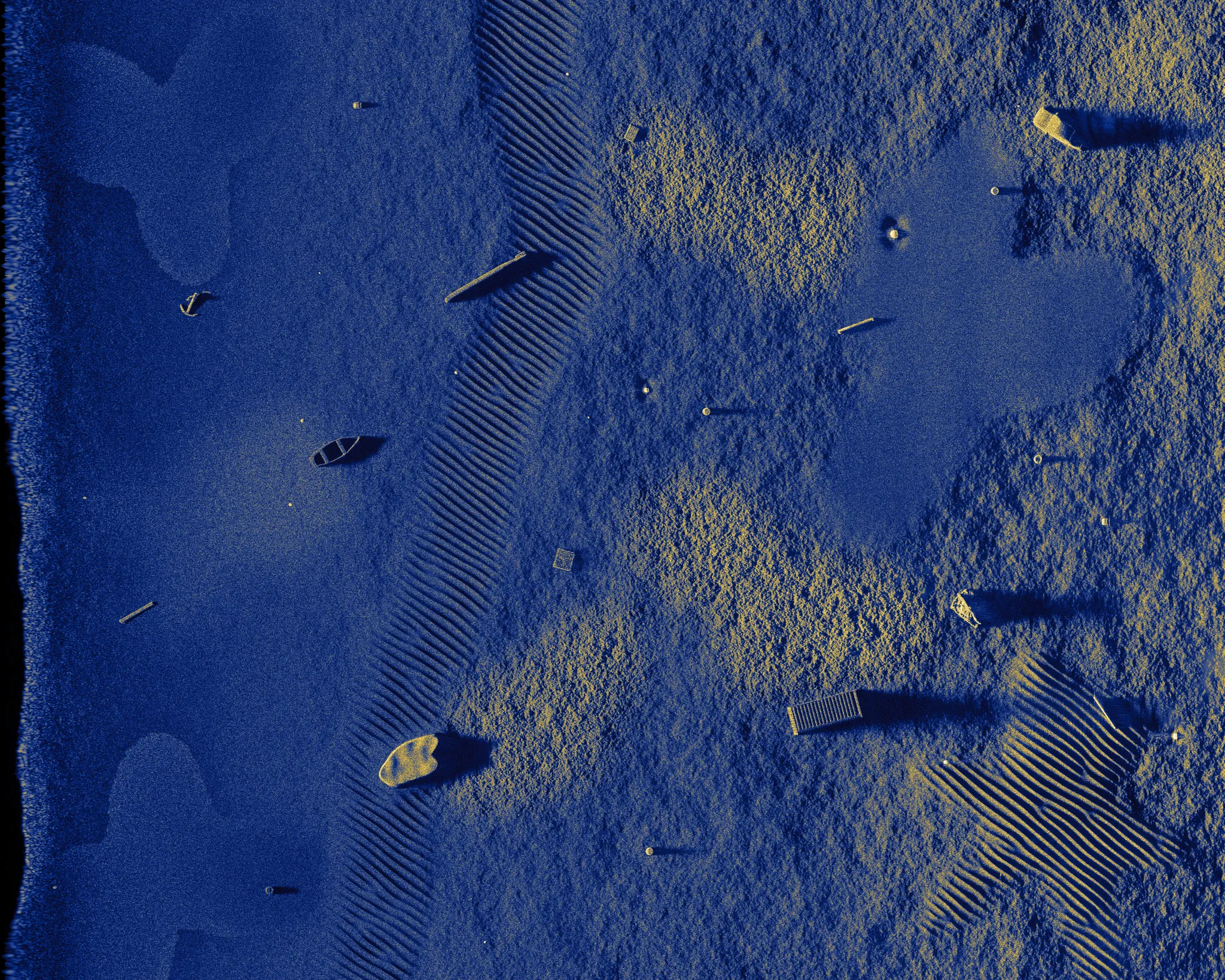
The scene is 80 m along track by 100 m in range and was simulated at 20,000 seafloor scatterers per square meter. It was imaged at 100 kHz with 30 kHz of bandwidth by a 32-channel array. Its seafloor is a patchwork of sand, rippled sand, mud, gravel and shell hash with a rock outcrop and sparse boulders. The scene holds eighteen man-made objects, among them a shipping container, a car, a small boat, a long cylindrical body, tires, barrels and pipes. Both images were simulated from the same scene file with the same seed; only the scattering model of the objects differs.

Synthetic aperture sonar image of a mixed seafloor with eighteen objects simulated as point scatterers; every object appears as a uniformly bright, speckled silhouette with its shadow
The divider moves by dragging, or with the arrow keys once it has focus. To the left of the divider the objects are point scatterers; to the right they are Kirchhoff facets. The faceted image is the same scene with its objects reduced to edges, corners and surfaces that face the sonar. Along track is up and range increases to the right. Each image has its own display normalization, so the seafloor appears the same in both.
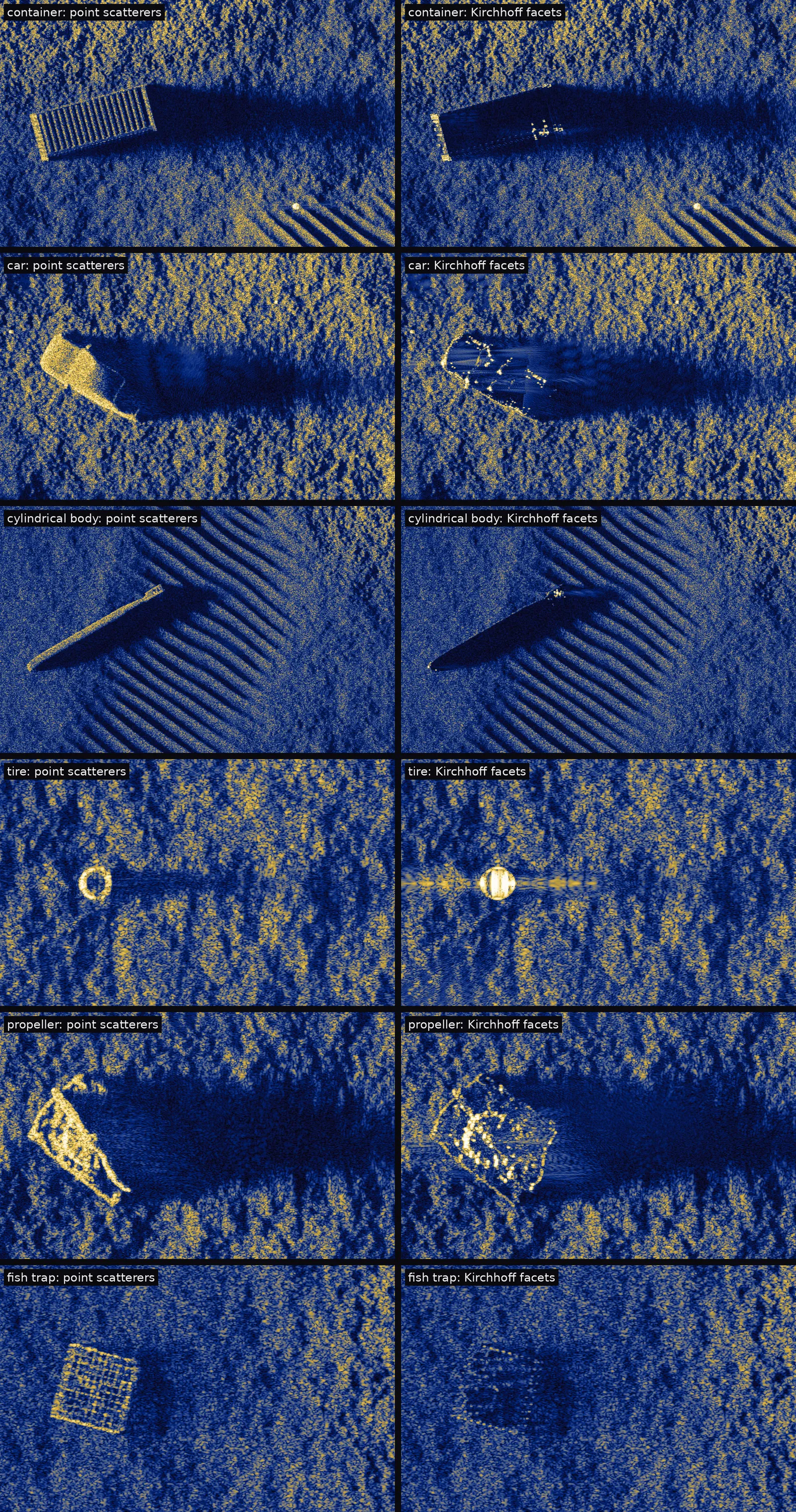
Six objects cropped from the two images, point scatterers on the left and Kirchhoff facets on the right: a container, a car, a long cylindrical body, a tire, a ship propeller and a fish trap
Six of the objects at full resolution, point scatterers on the left and Kirchhoff facets on the right: a shipping container, a car, a 7.6 m cylindrical body lying 60 degrees from broadside, an upright tire, a ship propeller and a fish trap. The shadows are identical in the two models, and only the returns from the objects themselves differ.

Points

Objects as point scatterers

In the point model, scatterers are drawn uniformly over the surface of the object's mesh at the scene's scatterer density. Each takes a random complex amplitude whose mean power is set by the object's target strength, which the scene file gives, and each radiates equally in all directions. The sum over many such points is a speckled return from every part of the object that the sonar can see.

The whole silhouette is therefore lit to a similar level at every aspect, and the brightness of the object relative to the seafloor is set by its target strength alone. The model describes a surface that is rough on the scale of the wavelength everywhere and has no specular component.

Facets

Objects as Kirchhoff facets

In the facet model, the mesh is subdivided until no triangle edge exceeds the smaller of 0.35 of the range resolution and 0.45 of the shortest wavelength in the band. For this sonar the bound is 5.9 mm, 0.39 of a wavelength at the center frequency. The echo of each triangle is the Kirchhoff integral over its surface, which Abawi (2016) evaluated in closed form for a non-penetrable triangle, and the echoes of all triangles are added coherently. Each object takes a rigid or a pressure-release boundary.

The level of an object, its highlights and its nulls then follow from its shape and the frequency rather than from a target strength. The implementation reproduces Abawi's closed forms for a plate, a disc, a cylinder and a sphere within 0.06 dB at broadside and 0.5 dB in the worst case. The validation ladder in the reference documentation gives the cases.

The eighteen objects in this scene subdivide into 41.3 million facets, which occupy 3.5 GB of GPU memory. On one workstation GPU the simulation took 4 min 28 s, against 4 min 2 s with point objects.

Interpretation

Specular reflection and the outline of an object

A smooth surface scatters coherently. In the Kirchhoff sum, the echoes of neighboring facets on a smooth surface arrive with a phase that changes steadily across the surface. They cancel except near points where the surface faces the sonar squarely and at the edges of the surface. The result is a specular reflection: a smooth face returns energy toward the sonar only when its normal lies close to the line of sight. The angle within which it does so is about one wavelength divided by the size of the face.

A synthetic aperture observes each point of the scene over a limited range of look directions. With this array the processed beam is 28.6 degrees wide, so each object is seen from within about 14 degrees of broadside. A face whose normal points outside that cone returns no specular echo at any point of the track. The cylindrical body in the scene lies 60 degrees from broadside, and its hull is represented by 2.8 million facets. The only part of it that faces the sonar is the rounded nose, which appears as a single glint.

What remains of each object is the set of features that do face the sonar: edges and corners, rounded surfaces, and flat faces square to the track. Rounded surfaces such as the upright tires, barrels and kegs present a specular point at every aspect. These features are bright, and the brightest pixel in the image rises by 14.2 dB with facets. The shadows are unchanged, because both models cast them from the same height map.

Objects on a real seabed seldom image as outlines. Corrosion, damage, settled sediment and marine growth make their surfaces rough on the scale of the wavelength, which is 15 mm at 100 kHz. Roughness at that scale scatters part of the energy diffusely, so that the body of an object returns a speckled echo at any aspect. A smooth facet carries none of this diffuse component, whereas the point model represents only the diffuse component.
Limits

Limitations

Each facet scatters once, from the transmitter to the receiver. Paths that include the seabed and paths between facets of the same object are absent. A dihedral or trihedral corner therefore does not return a corner reflector's level, and the bright line along the base of an object resting proud of the seabed is missing.

The facets of one object do not occlude one another. The inner faces of the container's walls and the interior of the car return echoes through the outer surfaces, and these appear as glints inside the outlines of those objects.

The facets are smooth. Without a roughness term the model describes only polished or freshly painted surfaces.

The boundary of an object is rigid or pressure-release. Elastic responses of shells and solids, which contribute to the echoes of metal objects at these frequencies, are outside the Kirchhoff approximation.

The facet count follows the surface area divided by the square of the edge bound, and the edge bound scales with the wavelength, so the count grows with the square of the frequency.

Extensions

Roughness and other extensions

The established way to extend a facet model toward rough surfaces describes the surface of each material by a roughness height and a correlation length. These two parameters divide the scattered energy between a specular and a diffuse component. For Gaussian roughness of rms height σ and correlation length ℓ, the coherent specular power falls by the factor exp[−(2kσ cos θ)2], where k is the acoustic wavenumber and θ the angle of incidence from the surface normal. The energy it loses is scattered into a diffuse lobe whose angular width is set by the rms slope of the surface, about √2 σ/ℓ (Ogilvy 1991). In reflectance terms this is a bidirectional reflectance distribution function with a specular lobe and a diffuse lobe, both derived from σ and ℓ. The same surface then images as smoother at low frequency and rougher at high frequency without any change to its parameters.

The Kirchhoff approximation is accurate only for roughness whose correlation length exceeds about one wavelength (Thorsos 1988). Roughness finer than that, such as marine growth, is described instead by its roughness spectrum through small-roughness perturbation theory, the approach ApertureLab uses for the seafloor. A two-scale model therefore represents roughness larger than the wavelength by displacing and tilting the facets, and roughness smaller than the wavelength by a diffuse term.

A related approach models the diffuse component with point scatterers whose mean amplitudes come from a deterministic scattering model and whose complex amplitudes are drawn from a circular Gaussian distribution (Brown, Johnson and Olson 2017). Applied to an object, the mean amplitude of each point follows from the local surface normal and the look direction. This combines the speckled body of the point model with the angular behavior of the facet model.

Two further extensions address the limitations above. Paths between an object and the seabed are modeled with the image method, which mirrors the object in the plane of the seabed and weights the mirrored paths by the reflection coefficient of the sediment. For a cylinder resting on sand, these paths contribute to the measured echo across aspect and frequency (Williams et al. 2010). The occlusion of an object's facets by its own surfaces is resolved by tracing a ray from each facet toward the sonar against the authored mesh.

References

Sources

  1. Abawi 2016. A. T. Abawi, “Kirchhoff scattering from non-penetrable targets modeled as an assembly of triangular facets,” Journal of the Acoustical Society of America, vol. 140, no. 3, pp. 1878–1886, 2016. The facet scattering model. doi.org/10.1121/1.4962735
  2. Ogilvy 1991. J. A. Ogilvy, Theory of Wave Scattering from Random Rough Surfaces, Adam Hilger, Bristol, 1991. Coherent attenuation and the diffuse lobe of a Gaussian rough surface.
  3. Thorsos 1988. E. I. Thorsos, “The validity of the Kirchhoff approximation for rough surface scattering using a Gaussian roughness spectrum,” Journal of the Acoustical Society of America, vol. 83, no. 1, pp. 78–92, 1988.
  4. Brown, Johnson and Olson 2017. D. C. Brown, S. F. Johnson and D. R. Olson, “A point-based scattering model for the incoherent component of the scattered field,” Journal of the Acoustical Society of America, vol. 141, no. 3, pp. EL210–EL215, 2017. pure.psu.edu
  5. Williams et al. 2010. K. L. Williams, S. G. Kargl, E. I. Thorsos, D. S. Burnett, J. L. Lopes, M. Zampolli and P. L. Marston, “Acoustic scattering from a solid aluminum cylinder in contact with a sand sediment: Measurements, modeling, and interpretation,” Journal of the Acoustical Society of America, vol. 127, no. 6, 2010. apps.dtic.mil/sti/pdfs/ADA510047.pdf
Next: the two simulation engines, or the facet model in the reference documentation.